 July
21
July
21
Tags
The Story Behind the Photo – Tibetan Tea
There are hundreds, if not thousands of photos from the trips we take. Some of them are pretty good and worth sharing, and they get posted to the blog, alongside an article, or on FaceBook. But some of the photos have deeper stories that are not revealed in the photo alone. This series, The Story Behind the Photo, tells some of those stories.
Tibetan Tea
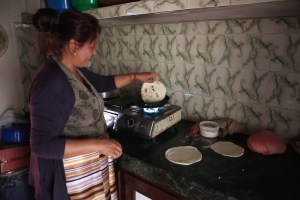
Our host prepares balep korun, Tibetan flat bread.
On a trip to Pokhara, Nepal, my travel companions and I visited a Tibetan refugee settlement, the Tashi Palkhiel Camp. Entering the camp, down its dirt and cobbled main road, we were met by haunting low throaty chanting of Buddhist prayers rumbling out from a golden-roofed monastery. We continued on and wandered through zig-zagging alleyways, between one-story, one-room, simple homes, accompanied by the sounds of fluttering prayer flags and an occasional pleasant greeting. The most memorable greeting came immediately after we squeaked past a lumbering black bull that gave us little notice and little room to pass. A woman, dressed in a long skirt and a colorful striped apron, smiled and approached. After a very short exchange of courtesies, she asked if we had ever had Tibetan tea, and in a few short minutes we found ourselves seated in her small, homey kitchen, cum bedroom, cum living room.
She quickly set to the duty of preparing the tea. Hot tea was combined with milk, butter, and salt which was emptied into a wooden butter churn.

Getting a chance to make traditional Tibetan tea.
She invited me to take a turn at churning the tea, but in under a minute she laughed, took back the handle, and excused me back to my seat. The tea was poured and then she took to flattening out dough, that was then fried in a skillet to make traditional Tibetan flatbreads, called balep korun. The bread was dull and doughy, and the tea, to our western tastes, undrinkable. I like tea, I like salt, and I like butter, but I don’t think I’ll ever want them combined again. We dutifully drank as much as we could stomach, exchanging encouraging glances at each other. She may have mistaken our eagerness to be polite as actual enjoyment for the tea, and she poured each of us a second glass.
We spent a pleasant hour with our host learning abut the village, her life in Tibet, her life in exile, and the graciousness of a stranger. We insisted on purchasing some of her handmade jewelry and she insisted on giving us a few of them as gifts. She was a woman who had lost so much; her roots, her country, and her home, but yet she extended herself to commit an act of kindness to total strangers.

Sitting inside a pleasant Tibetan home.
 That Estonian Girl