 April
11
April
11
Tags
A Grain of Sand in the Empty Quarter
I’ve failed. They still lie there shaking their heads and yawning lazily, despite my numerous attempts to use guilt and humor to get my companions to keep their promise, and tackle the gorgeous but steep 200 meter sand dune together. I am left alone, face to face with the giant.
(As seen on Fathom)

 I had talked my American, Iraqi, Canadian and Finnish friends into camping in the desert. About a four hour drive south from Dubai, United Arab Emirates, lies the massive Rhub Al Khali or Empty Quarter Desert. It is the biggest continuous sand desert in the world, covering 650,000 square kilometers. It is mostly contained within Saudi Arabia, but also reaches into Oman, Yemen and the United Arab Emirates. It is a home and a playground to Bedouins and their camels. Within the UAE it is also an amazing opportunity for tourists to
 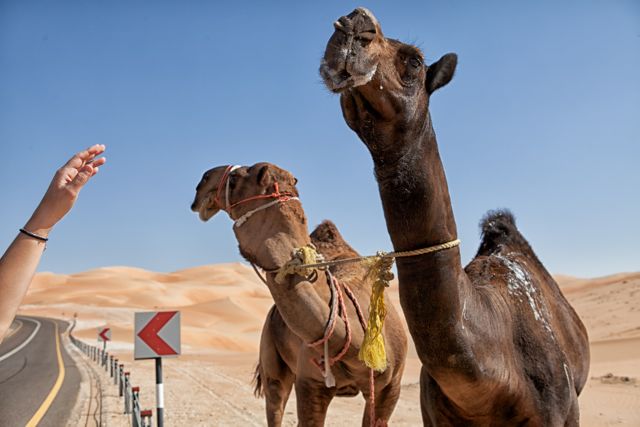 experience a Bedouin lifestyle and pitch their tent free of charge, almost anywhere they desire, and without ever being disturbed by anybody other than possibly, a friendly local or a roaming camel, wishing to say “hello”; something not so common anywhere else in the world.
The conventional wisdom says that travel to the Empty Quarter is no “joke” dangerous, and requires serious preparation with at least three four-wheel-drive vehicles to complete the journey. This is a standard desert off-road driving practice which ensures that if one of the cars gets stuck in the sand, which is pretty much inevitable, the second car can pull it free. If the second car gets stuck, the third can get everyone out safely.
However, if you forgo the serious dune bashing and simply take the asphalt roads and gravel tracks which wind through the desert, a single 4×4 vehicle can avoid plunging into the hazardous dunes and travel alone. With short notice and only one 4×4, we decided to attempt our journey on asphalt and gravel. The five of us packed up tents, sleeping bags, flashlights, cell phones, fire wood and food, and hit the road from Dubai.
After a few hours of dull flat grayish sand, the desert finally started to show a whole other side of itself. The sand became deep reddish-orange. Free roaming camels were now a regular sighting on top of the flowing dunes. As we moved along the winding highway, the dunes on both sides grew in size and changed in shape and form. We really started to get a sense of this powerful wilderness. The sands from the dunes floated over the road in thin layers as a constant reminder from the desert, of who’s really the boss here and how easy it would be for it to claim it all back.
 Sunset was fast approaching so we took our chances with one of the nearby tracks off of the main road which led deeper into the desert. We let out some air from the tires, switched into four wheel drive and continued along the road to look for a place to pitch the tents. We passed a few “sabkhas,” white salt flats, a remnant and reminder of the ancient lakes that used to exist here. Until today rainfall causes them to soften and can become impassable by even a very capable 4×4.
We soon came upon a monster of a dune hunkered down on one side of the road. Across from it was a flat area nestled inside a large three sided bowl of soft, undulating red sand. The deal was sealed and a unanimous decision made; we had found the perfect campsite.
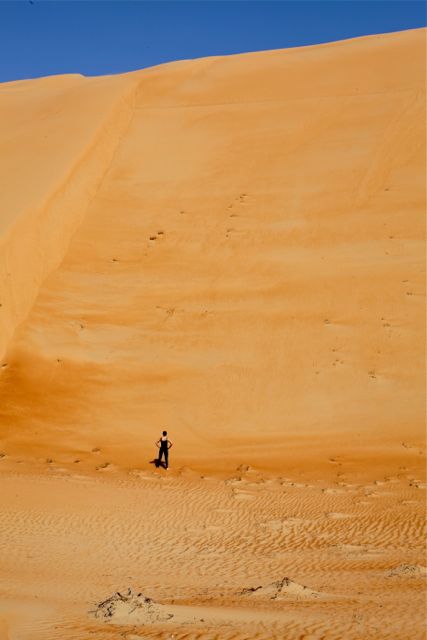 For as far as we could see in any direction there was no sign of life. Only the giant dune loomed over us, 200 meters high. We stared up at it in awe and imagined what the views would be like from the top. We swore that in the morning we would climb it, together.
The rising sun woke us as it broke through the cool morning air. Before long, I was restless to start the promised journey up the dune which, sat quietly taunting me; but my friends apparently had forgotten their promise to climb it together. I couldn’t imagine missing the opportunity to climb that dune and experience the view from its top, missing out on an authentic and once-in-a-lifetime experience. So, I crossed the road alone.
I sunk with each step I took. Grain by grain the sand quickly crumbled over and covered my feet deep into the dune. Realizing that walking was not working, I dropped down to hands and knees and crawled forward. The sun was getting higher and hotter by the minute and I felt myself getting out of breath. After a total of 20 minutes of exhaustive scrambling I finally reached the top.
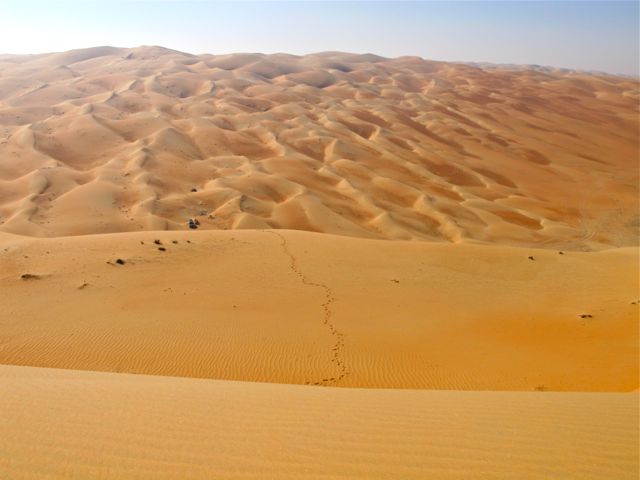 Looking over the horizon, I had never before witnessed such a view. The golden dunes lied unbroken in every direction like waves across the ocean. The Bedouins refer to the Empty Quarter as the sea of deserts and now I know why. High up on the shoulders of this monster dune, the silence was almost disturbing as I literally could not hear a thing; absolutely nothing. I contemplated how powerful, hostile and gorgeous this environment is and how tough the beduins must be to survive here. I wondered how long it will take, if ever, until the word really gets out and this becomes a national park, complete with entry fees and groups of people everywhere. I wished my friends were here to experience this moment with me, but I was equally, albeit guiltily, pleased to have this unique opportunity to myself.
Taking long leaps back down to the camp, the sand came alive, making unexpected musical sounds and squeaks, singing out every time I landed and slid along. In a few short minutes I was back to the bottom, leaving behind a long vertical trail, that in few hours would be smoothed over by the desert winds, leaving no trace of my presence.
To Get There
There are two options to get to the Empty Quarter from Dubai. Either take route E11 past Abu Dhabi towards the town of Madinat Zayed. Or take the road toward the Abu Dhabi airport, turning off onto the Tarif road at Junction 306 and heading toward Hemeem. This route will take a bit longer, but is more scenic and allows you to make a stop at the Emirates National Auto Museum on the way. Both of these routes will head out to Liwa Oasis, a strip of villages bordering the Empty Quarter. From there you simply follow signs to Al Moreeb Hill, a location used for competitive hill climbs.
 That Estonian Girl